


White Opal
Illumination, Consciousness & Inner Light
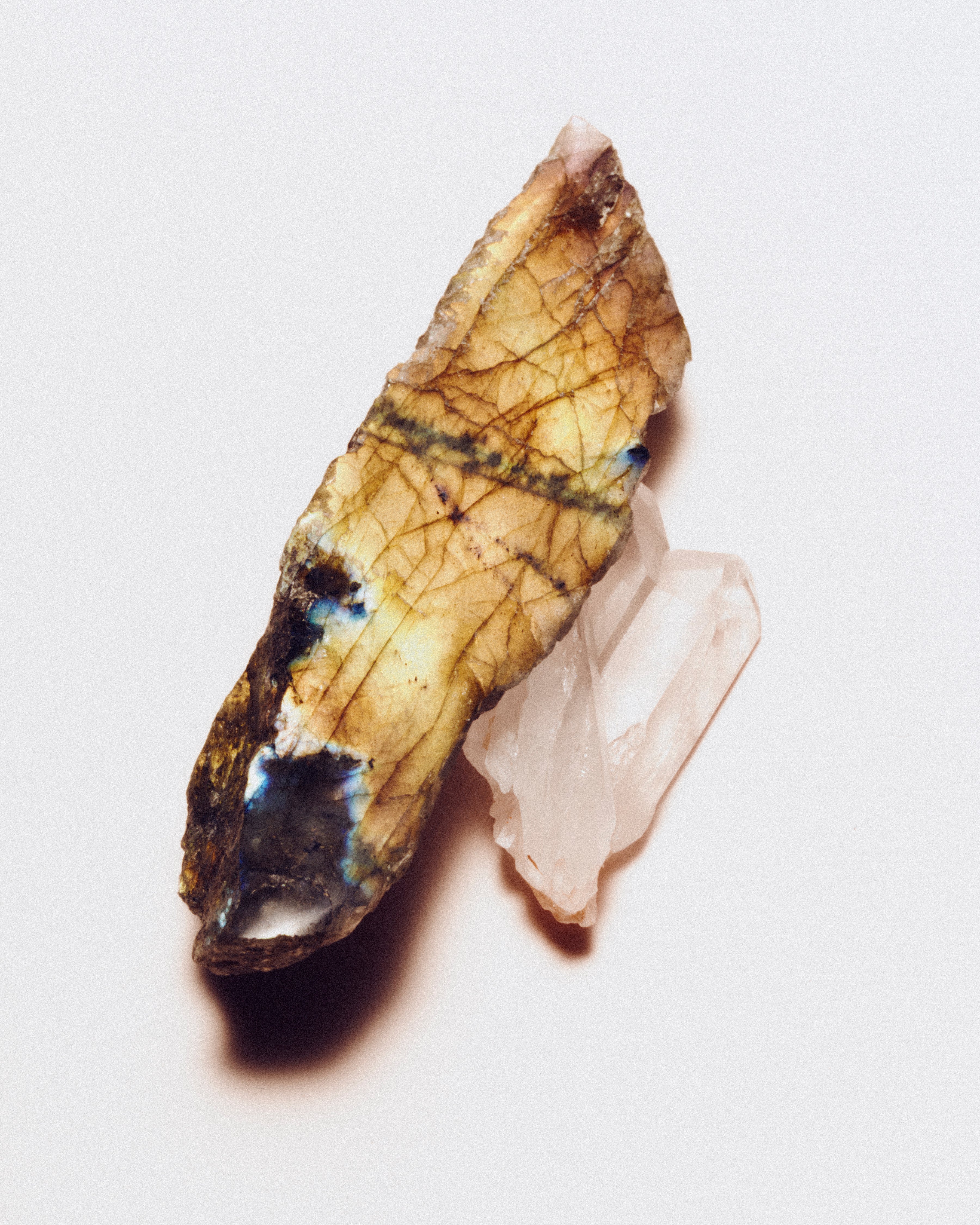
White opal does something no other gemstone does: it holds all the colors of the spectrum inside a stone that appears, at first glance, to be almost colorless. Turn it in the light and it answers with a full, shifting play of green, blue, red, orange, and violet, a phenomenon called play-of-color that is caused by the diffraction of light through microscopic silica spheres arranged within the stone's internal structure. It is the most optically complex of all gemstones, and arguably the most alive.
This quality has made opal mythologically potent across cultures. The ancient Romans considered it the most precious of all gems precisely because it contained all the others. They called it opalus, believed to derive from the Sanskrit upala, meaning precious stone. Indigenous Australian traditions, where the world's finest opals are found, describe the stone as the place where a rainbow touched the earth. Arabic legend held that opal fell from the sky in flashes of lightning. Every culture that encountered opal understood intuitively that it was doing something extraordinary with light.
Rarity and Formation
Opal forms through a remarkable geological process. Silica-rich water percolates down through sedimentary rock, and under very specific conditions of temperature, pressure, and silica concentration, the silica precipitates into tiny uniform spheres that stack in a regular three-dimensional lattice. It is this crystalline arrangement, not any chemical coloring agent, that diffracts visible light into the colors seen in the play-of-color. The uniformity and size of the spheres determine which colors are produced: larger spheres generate red and orange, smaller spheres produce blue and violet.
White opal, also called light opal or white base opal, has a milky to white body color with play-of-color appearing across its surface and interior. Fine specimens show a broad, bright, multicolored play against a clean white background, a visual richness that collectors call the pattern. Rolling fire, harlequin, and pinfire are among the most prized patterns, each describing a different quality of color distribution across the stone.
Australia produces over 90 percent of the world's precious opal. The Lightning Ridge region of New South Wales is famous for black opal, the rarest and most valuable variety, while Coober Pedy in South Australia is the primary source of white opal. Ethiopian opal, discovered in commercial quantities in the late twentieth century, has introduced a new category of highly sought-after material, particularly for its vivid play-of-color in crystal and semi-crystal base material.
Fine white opal with strong, multi-colored play and a clean background is significantly rarer than the abundant low-grade material that floods the market. At Opaze, we select for the specificity and brightness of the play-of-color, which is what separates a genuinely special opal from an ordinary one.
Energy and Intention
White opal is associated with expanded consciousness, spiritual awareness, and the amplification of all that is already present within the wearer. Because it holds all colors within itself, it is considered a stone of wholeness: a reminder that seemingly disparate aspects of the self can coexist, and even illuminate each other.
It is most commonly associated with the crown chakra, the energy center governing our connection to higher consciousness, universal awareness, and the sense of being part of something larger than the individual self. White opal is said to open and activate this center, facilitating a more direct experience of insight, clarity, and spiritual presence.
In many traditions, opal is considered a deeply reflective stone, one that magnifies the inner emotional landscape of its wearer. This quality is sometimes described with caution: opal is not a stone that hides what is present. It is said to bring everything into visibility, which makes it particularly useful for those committed to honest self-examination and less suited for anyone who is not ready to see clearly.
White opal is associated with purity of intention: the alignment of thought, word, and action around what is genuinely true for the wearer. In this sense, it supports integrity in the deepest meaning of that word, not as a moral performance but as a coherence between inner experience and outer expression.
It is also associated with creativity and inspiration. Many artists and writers who work with stones are drawn to opal specifically, and the connection seems intuitive: a stone that contains all colors within itself naturally supports the full range of human expression.
How to Wear It
Opal requires some care as a gemstone: it is relatively soft and contains water within its structure, making it sensitive to extreme heat, dryness, and strong chemicals. Bezel settings that protect the edges are a thoughtful choice. With reasonable everyday care, however, it wears beautifully as a regular piece.
White opal works particularly well in minimalist settings that allow the stone's own visual complexity to speak without competition. Gold brings warmth to the white base, while silver or white gold creates a cooler, more ethereal quality. Worn alone as a pendant close to the throat or heart, a fine white opal has an almost meditative quality: something to return your eyes to throughout the day as a reminder of depth and light.